The Drifting Double: Urban Digital Twins and the Maintenance of Truth
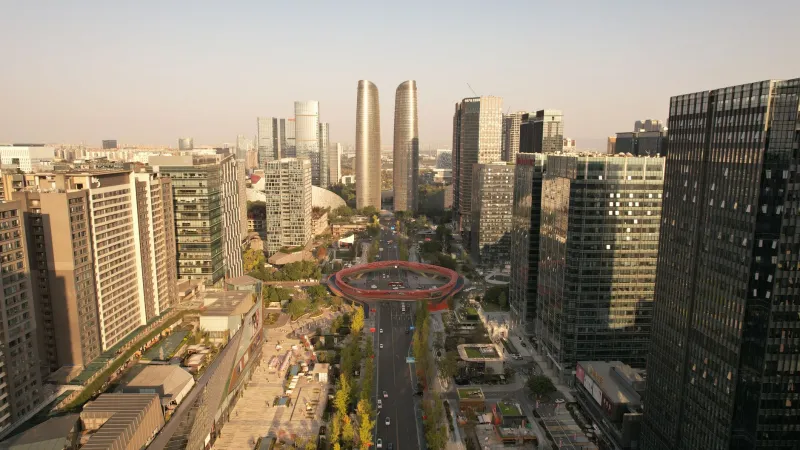
Across the United States, the digital twin has moved from vendor demonstration to budget line item. A Midwestern water utility may maintain a hydraulic model of thousands of miles of pipe. An East Coast transit agency may run a passenger-flow simulation before changing a bus route. A Western city may build a neighborhood-scale model to test heat, flooding, or zoning scenarios. The pitch is straightforward: simulate first, spend later, and avoid expensive mistakes.
The difficulty is not that these models are wrong. Every model is wrong in some measure. The difficulty is that a digital twin can remain persuasive long after it has stopped being current. Sensors age. Budgets shift. A neighborhood adds a block of apartments, loses a grocery store, or changes its commuting patterns. The model keeps rendering. The dashboard keeps glowing. The gap between the mirror and the city widens quietly.
The Half-Life of a Sensor
Digital twins depend on data streams that are often treated as permanent. In practice, a flow meter installed in 2019 may still report a number in 2026 even as its calibration drifts. A traffic camera may be replaced, but its new field of view may not be reconciled with the old model. A pipe network may be repaired in ways that never reach the simulation team. Municipal budgets rarely fund sensor replacement at the same cadence as software updates.
This is not a failure of any single device. It is a systems problem. The model is only as honest as its maintenance record, and maintenance records are rarely displayed on the public dashboard.
Verification Is a Verb
Verification for a digital twin cannot be a one-time acceptance test. It has to be a recurring practice: calibration schedules, validation against independent field surveys, comparison with holdout data, uncertainty ranges, versioned model releases, and public change logs. A model that cannot state its confidence interval is not a planning tool. It is a screenshot.
Some cities are beginning to treat models more like software, with release notes and rollback plans. That is a useful start. But software version control does not solve the harder problem of ground truth. A model can be internally consistent and still be wrong about the street.
Who Gets the Correction Pen?
Correction authority is a governance question, not a technical footnote. The municipal GIS team may hold the official data, the contractor may hold the model, and the utility may hold the operational knowledge. Residents often hold the most current ground truth of all. A resident may know that a culvert floods every spring, that a bus stop is unusable after dark, or that a new development changed drainage patterns months before the maps catch up.
If those observations have no route into the model, the digital twin becomes a closed loop. Cities should name who can correct the model, how quickly corrections are published, and how disagreements are resolved. Community review boards, public issue trackers, and mandatory disclosure of model limitations are not bureaucratic extras. They are part of the verification system.
Forecast Meets Pavement
When a confident digital forecast collides with real infrastructure, the cost is not only money. It is credibility. A flood model that predicts a dry intersection while basements fill will struggle to win trust for the next capital plan. A transit simulation that assumes riders will walk farther than they actually will can produce a route that looks efficient on screen and fails on the street.
The answer is not to abandon models. The answer is to design them for doubt. Three practices matter. First, publish a maintenance schedule and a data provenance record alongside the model. Second, separate exploratory views from decision-grade views so that a rough scenario is not mistaken for a verified forecast. Third, fund correction as a line item, not as an afterthought.
A digital twin should be treated less like a finished mirror and more like a public record: versioned, auditable, and open to correction. The mirror city will never be the city. But it can be an honest instrument if its keepers are willing to show where it has drifted.